
CoEfficiant journal
HiggsField: What is HiggsField.ai ..and why is craze around it ??
An architectural deep dive into Higgsfield.ai — why it is fundamentally an AI filmmaking production studio rather than just another text-to-video generator, how its 1,296 lens combinations and camera controls work, and why its $5.4B valuation is reshaping generative media.
HiggsField: What is HiggsField.ai ..and why is craze around it ??
The generative video landscape has experienced an unprecedented flood of foundational breakthroughs over the past eighteen months. Models like OpenAI's Sora, Google's Veo, Kuaishou's Kling, and ByteDance's Seedance have demonstrated breathtaking synthetic fidelity. Yet if you speak to working film directors, creative technologists, commercial cinematographers, or enterprise production heads, an uncomfortable truth quickly emerges: generating a single hyper-realistic five-second clip is easy; directing an intentional, continuous, multi-shot cinematic narrative with AI has been virtually impossible.
This fundamental bottleneck is precisely why Higgsfield.ai has suddenly captured the intense fascination of both Silicon Valley venture capital and global creative studios. Valued at $5.4 billion following its $400 million Series B funding round reported in August 2026, Higgsfield is not merely another "text-to-video prompt toy." It represents a deliberate paradigm shift from raw generation engines to an end-to-end virtual film studio and camera operating system.
Visual reference: Higgsfield.ai Cinema Studio workspace.
The Critical Distinction: Generation Engines vs. Production Platforms
To comprehend why the industry is treating Higgsfield differently from standard text-to-video generators, one must understand the architectural layer cake of generative media:
Generation Engines (Sora, Veo, Kling, Seedance): These are foundational compute engines. You provide a natural language prompt, and their diffusion transformer architectures calculate pixels. However, they operate like a casino: you pull the prompt lever, and the machine dictates the camera angle, the actor's gaze, the lighting setup, and the focal length. If the camera drifts unpredictably or pans the wrong direction, your only recourse is to re-roll the prompt and burn more compute.
The Production Layer (Higgsfield): Higgsfield decouples artistic intent from raw model inference. It wraps both proprietary models and leading third-party engines into a cohesive cinematographic workflow. It treats camera movement, lens optics, lighting, character identity, and shot pacing as independent, directed parameters rather than randomized statistical side-effects of text tokens.
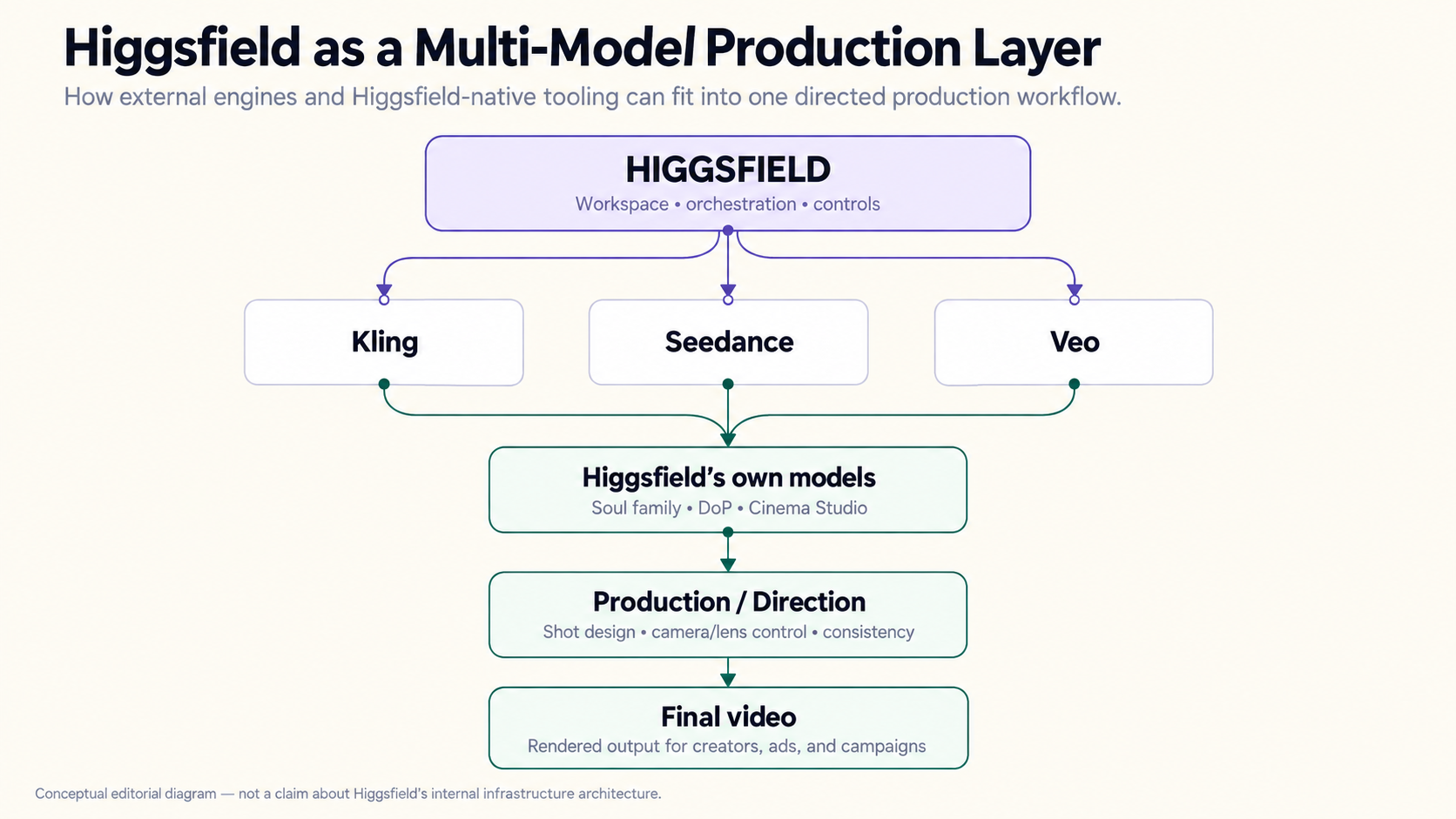
Conceptual editorial diagram — model availability changes over time and does not represent internal infrastructure implementation.
In short: Sora, Veo, and Kling are the raw rendering engines; Higgsfield is the virtual film studio and director's console.
Why Creators and Studios Are Paying Attention: Absolute Camera Control
With first-generation AI video tools, a filmmaker prompt like "A detective walking through a neon-lit alley in Tokyo in rain" produced a random shot — perhaps a distant wide, perhaps an extreme close-up, drifting on an unpredictable trajectory. If you needed a dolly-in matching a reverse angle or a continuous orbit around the detective's face, standard tools offered zero control.
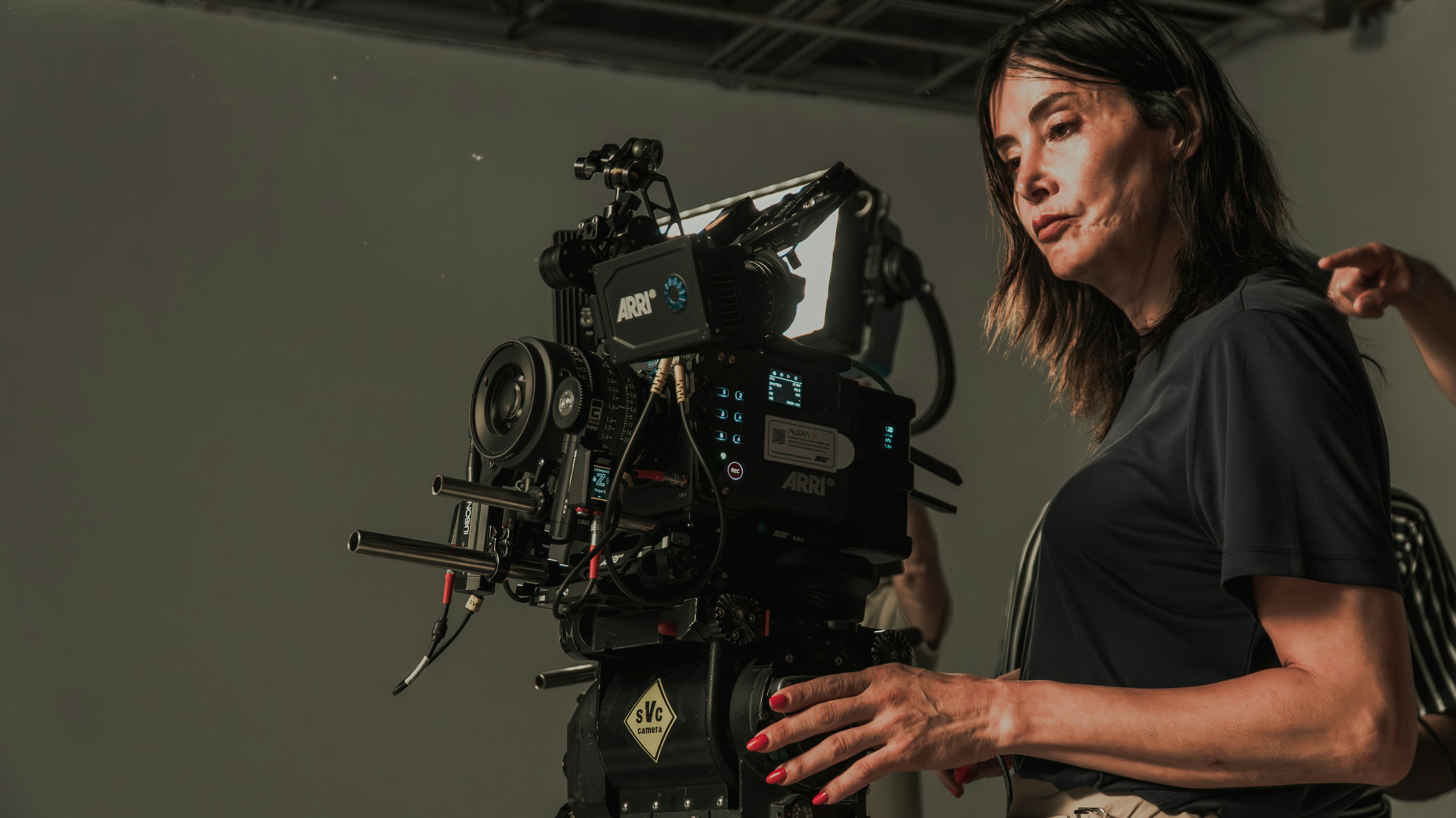
Photo: Cemrecan Yurtman / Unsplash. Professional filmmaking is built around deliberate choices in framing, optics, and camera motion — the control model Higgsfield is bringing into generative video.
Higgsfield tackled this control deficit by introducing dedicated camera and optical controls directly into its Cinema Studio interface:
Kinematic Rig Moves: Direct control over classic cinematographic camera trajectories — Dolly In/Out, Jib & Crane movements, 360° Subject Orbits, Crash Zooms, Whip Pans, handheld camera motion, and FPV drone fly-throughs.
Cinema Studio 4.0 Workspace: Powered by the Seedance 2.5 engine, Cinema Studio 4.0 provides a dedicated Director's Panel, support for up to 50 reference inputs, video clip durations up to 30 seconds, 50+ color grading presets, and granular optical parameters.
1,296 Camera & Lens Configurations: According to Higgsfield, Cinema Studio exposes over 1,296 camera lenses, cinematic parameters, and color grading configurations — allowing creators to specify vintage 16mm film aesthetics, anamorphic primes, specific focal lengths (24mm, 35mm, 50mm, 85mm), and precise aperture depth-of-field.
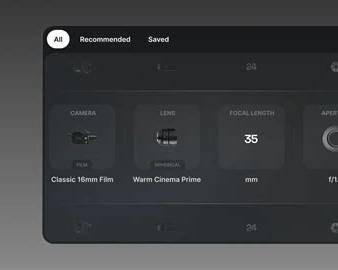
Higgsfield Cinema Studio interface: Granular selection of Camera types, Cinema Lenses, Focal Lengths, and Apertures.
Proprietary Tools: Soul Cinema, Soul 2, and DoP
Alongside third-party model access, Higgsfield has developed its own suite of specialized creative tools:
SOUL Cinema (Cinematic Image Model): SOUL Cinema is Higgsfield's flagship image-generation model, engineered specifically for high-aesthetic cinematic keyframes, atmospheric lighting, volumetric depth, and reference frames for downstream video generation.
Soul HEX (Color Palette Control): A dedicated color engine that allows directors to define and lock exact hex color schemes across their scene compositions for consistent look development.
Soul ID (Character Consistency): Helps solve identity drift across multi-shot sequences by preserving facial likeness, wardrobe, and character attributes across varying lighting conditions and camera setups.
DoP (Director of Photography): A specialized camera and framing assistant within the Higgsfield suite that helps guide composition, shot angles, and visual pacing.
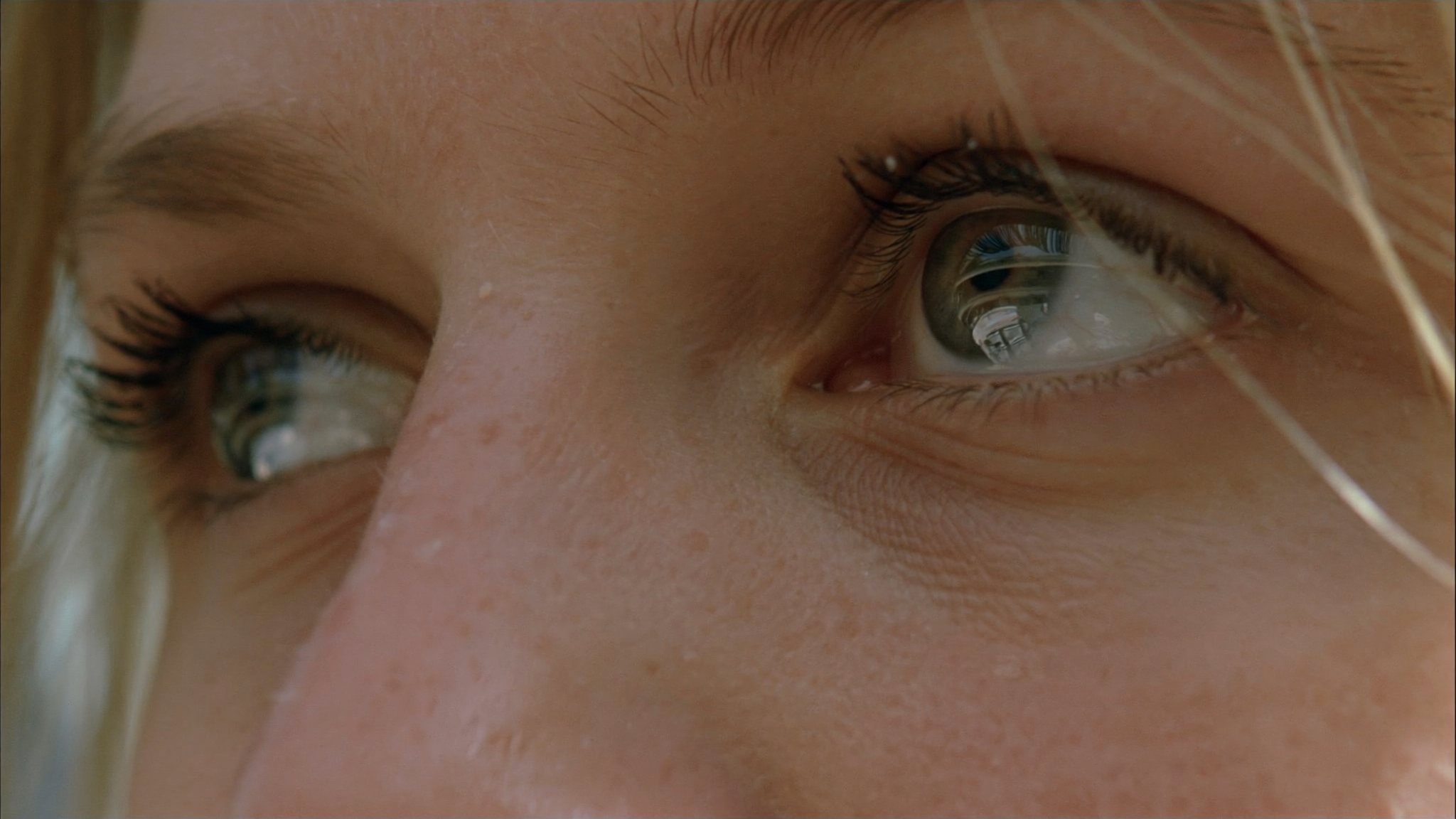
Visual reference: Higgsfield.ai SOUL Cinema keyframe generation.
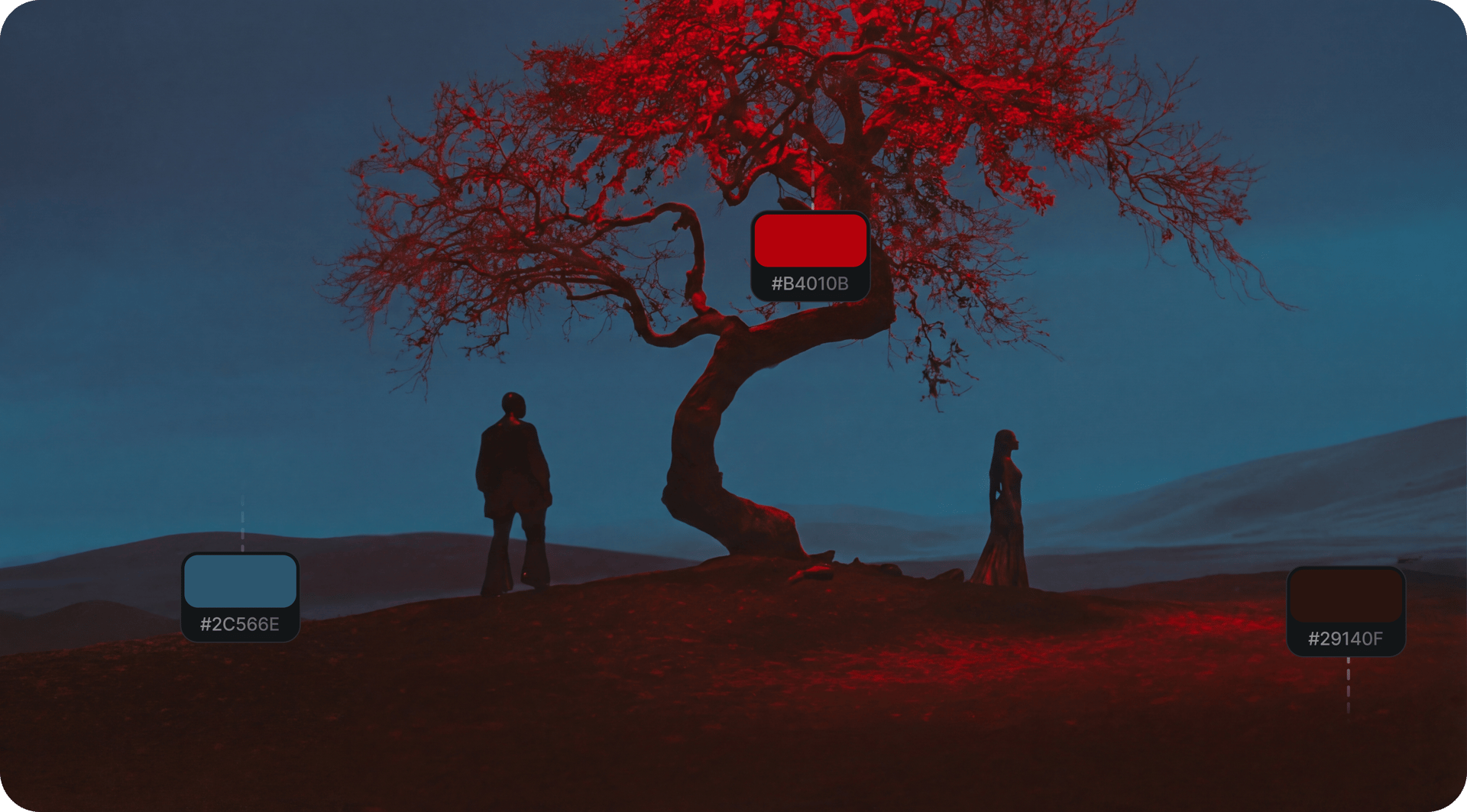
Visual reference: Higgsfield.ai SOUL HEX color palette control.
The Multi-Model Ecosystem: 50+ Engines Under One Unified API
Another key pillar of Higgsfield's strategy is that it avoids locking studios into a single proprietary silo. Because the foundation model landscape evolves weekly, production teams need flexibility to route shots to whichever model performs best for a specific visual challenge.
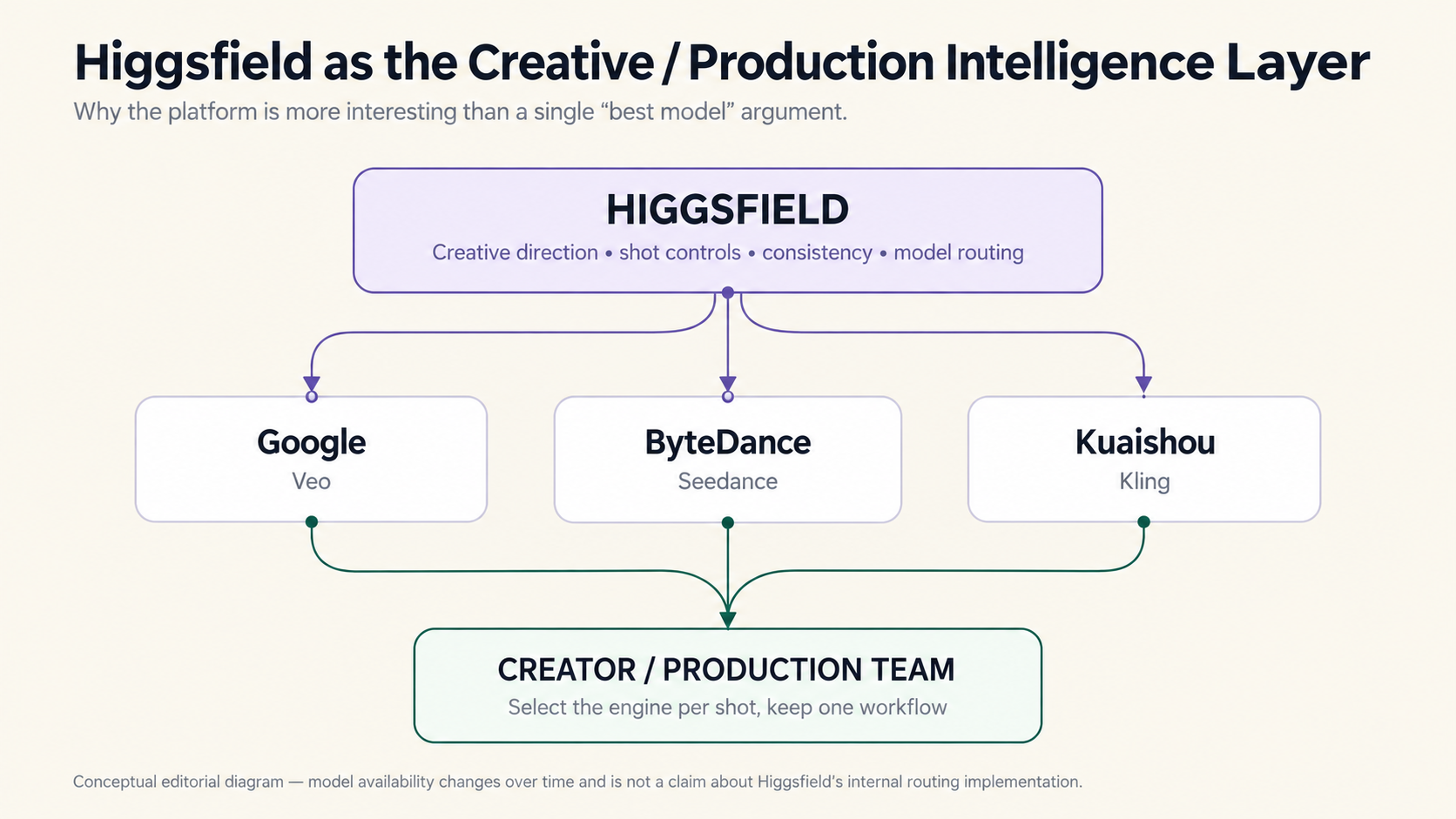
Conceptual editorial diagram — model availability changes over time and is not a claim about Higgsfield's internal routing implementation.
Higgsfield serves as both an aggregator and a developer orchestration platform:
50+ Current Generation Models: The catalog spans industry-leading video and image models including Kling, Seedance, Wan, MiniMax, LTX, PixVerse, Recraft, Ideogram, and Grok families, alongside native Soul 2, Soul Cinema, and DoP models.
Unified Developer API & SDKs: Developers can access this multi-model catalog via standard REST endpoints and official Python and TypeScript SDKs, backed by a single USD balance and predictable pay-per-generation pricing — eliminating the friction of managing dozens of individual vendor accounts.
Automated Reframe: Solving the Multi-Platform Delivery Challenge
Modern production mandates distributing the same campaign creative across conflicting aspect ratios: 16:9 cinematic widescreen for YouTube and broadcast, 9:16 vertical for TikTok and Instagram Reels, and 1:1 square for sponsored feeds. Traditionally, reframing required manual pan-and-scan editing that often clipped crucial subject action.
Higgsfield's Intelligent Reframe allows creators to dynamically transform the aspect ratio while keeping the key subject framed and centered, generating surrounding context seamlessly for rapid cross-channel asset packaging.
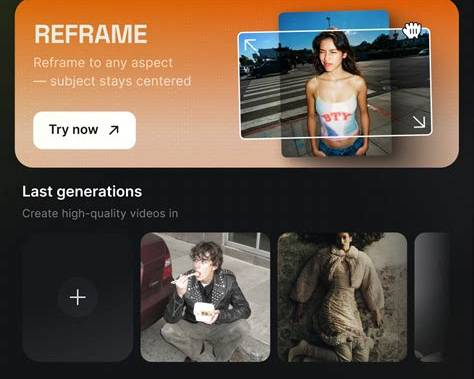
Higgsfield Reframe: One-click aspect ratio conversion that automatically anchors and tracks subjects.
The Complete End-to-End Production Pipeline
Higgsfield organizes generative video into an integrated workflow from preliminary concept through final post-production finishing:
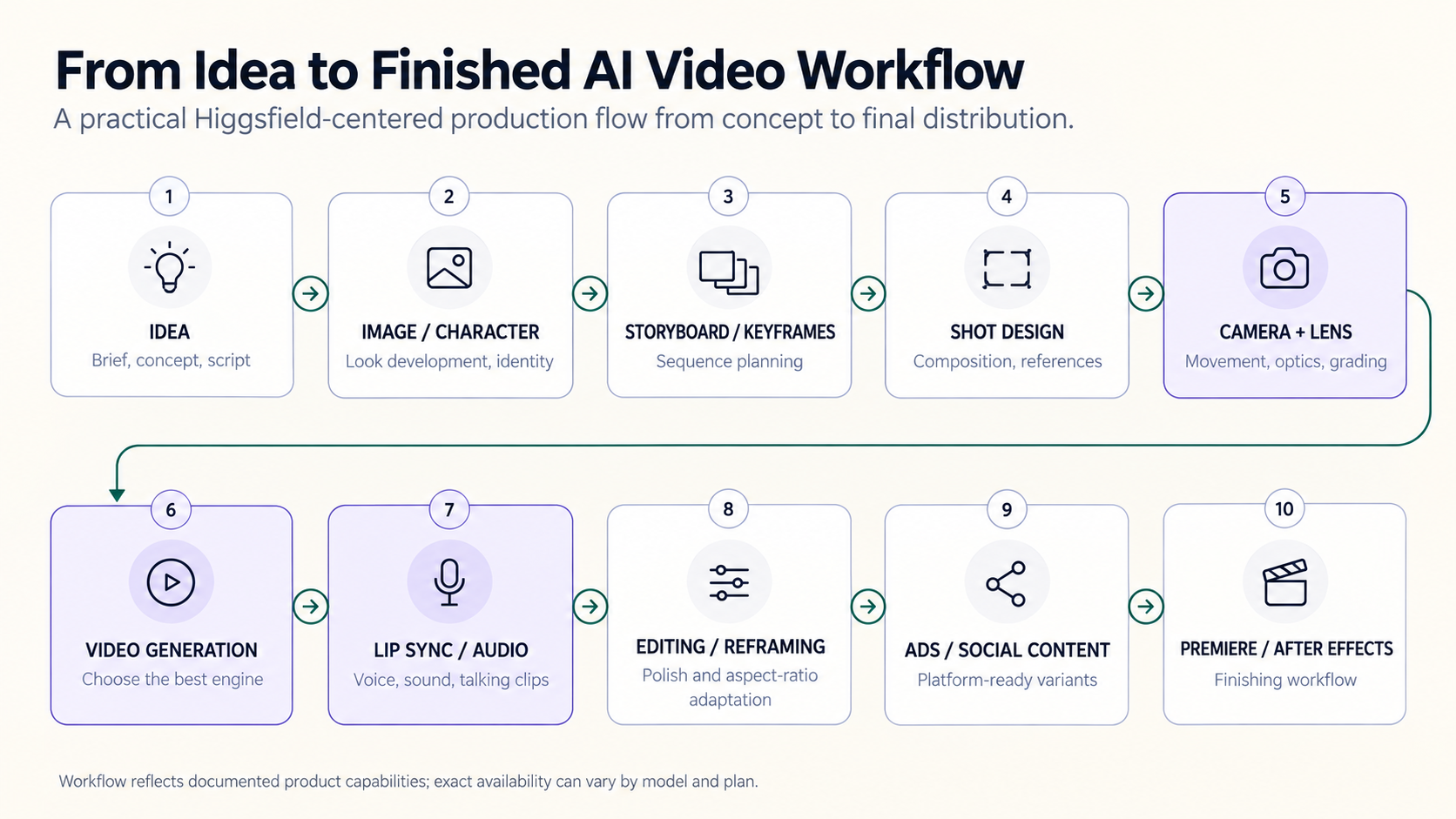
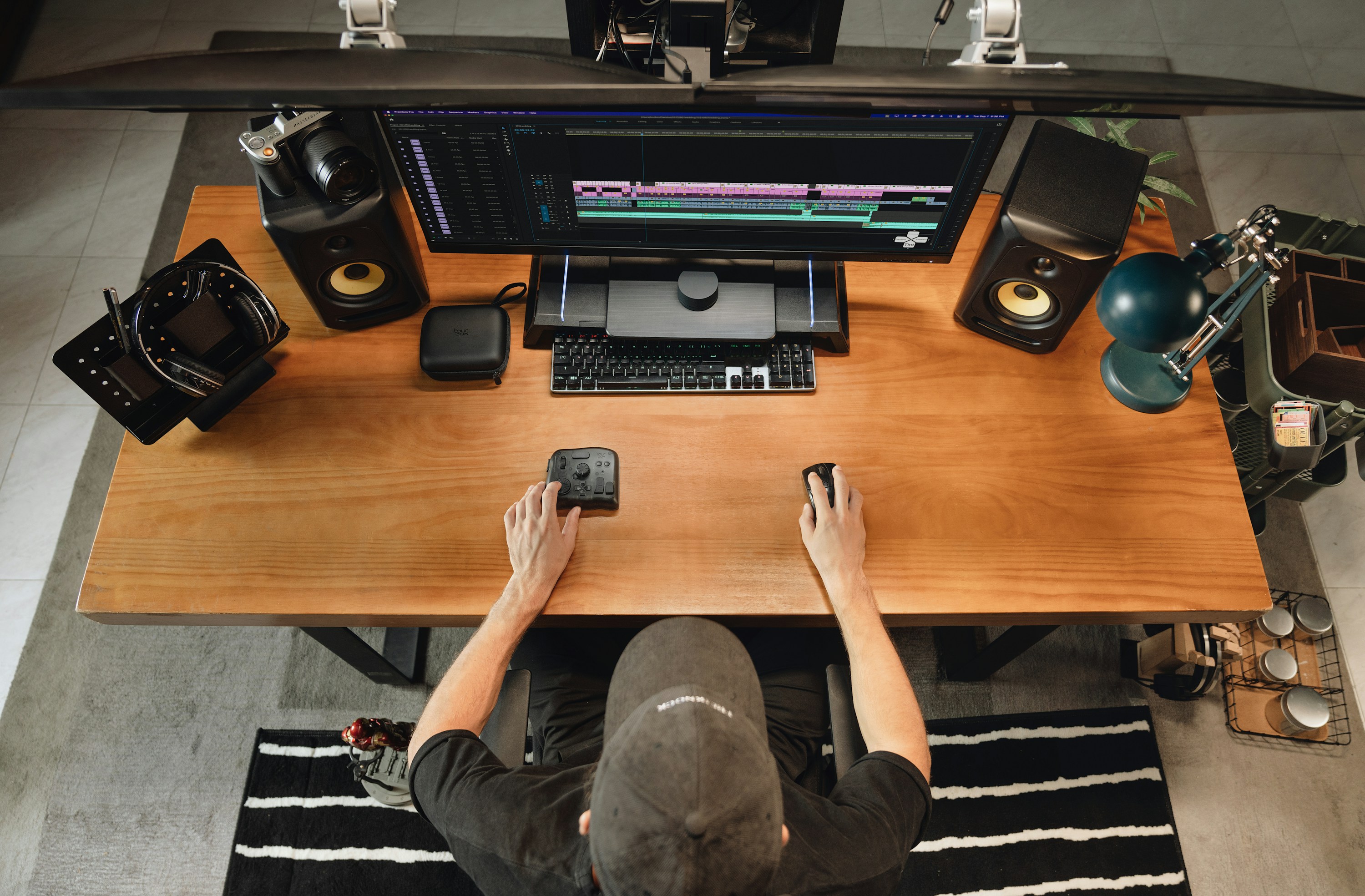
Photo: TourBox / Unsplash. Traditional NLE finishing: bridging generative video generation with post-production timelines in Premiere Pro and DaVinci Resolve.
Idea & Script Breakdown: Conceptual brief, narrative arc, and structured beat sheet.
Look Development & Character Design: Creating locked character references and aesthetic benchmarks with SOUL Cinema.
Storyboard & Keyframing: Generating sequential scene anchors to establish continuity.
Shot Design & Framing: Setting composition, lighting references, and scene staging.
Camera & Lens Direction: Specifying virtual focal length, camera motion rig (dolly, crane, orbit), and aperture in Cinema Studio.
Multi-Engine Video Generation: Selecting the optimal engine (Kling, Seedance, Veo, or Soul 2) per shot requirement.
Voice & Lip-Sync: Multi-lingual voiceover generation and phoneme-accurate lip synchronization.
Reframe & Edit: Adapting native renders into platform-specific aspect ratios (16:9, 9:16, 1:1).
Social & Campaign Packaging: Creating targeted creative cuts for paid and organic distribution.
NLE Post-Production Finishing: Bringing exported video assets into Adobe Premiere Pro or DaVinci Resolve for final sound design, color mastering, and graphics overlay.
By the Numbers: Valuation and Adoption Milestones
According to reporting by TechCrunch and Reuters in August 2026, Higgsfield's commercial growth has broken records for generative creative tooling:
| Metric | Reported Milestone (August 2026) | Source Attribution |
|---|---|---|
| Valuation | $5.4 Billion Series B | Reported by TechCrunch and Reuters (August 2026), quadrupling from $1.3B in eight months |
| Capital Raised | $400 Million | Led by prominent institutional venture firms |
| User Community | 30+ Million Users | Reported by Higgsfield to TechCrunch |
| Annualized Revenue | Over $700 Million ARR | Reported run-rate across studio subscriptions and API consumption |
| Enterprise Adoption | 390 of the Fortune 500 | Reported by Higgsfield across agency, brand, and media engagements |
Note: Metrics reflect published August 2026 reporting; Higgsfield's legacy FAQ previously cited 25M users and a $1.3B valuation.
Production Realities and Tradeoffs
While Higgsfield offers impressive workflow leverage, technical leaders and creative teams should account for several practical engineering realities:
Credit Consumption & Compute Budgeting: Multi-shot iterations, 4K rendering, and multi-model experimentation burn compute credits quickly. Enterprise teams must establish governance guardrails to monitor usage against campaign budgets.
Queue Latencies: High-demand foundational models can experience variable queue times during peak hours on non-priority tiers.
The Moving Foundation Target: Foundational models evolve rapidly. Aggregation mitigates lock-in, but creative teams must continuously calibrate prompts and shot presets as underlying model weights update.
The CoEfficiant Take: Engineering Enterprise Generative Media Pipelines
At CoEfficiant, we partner with mid-market enterprises, digital media organizations, and consumer brands to build production-grade AI capabilities that turn bleeding-edge tools into measurable business value.
The craze around Higgsfield confirms what we have championed across our AI Enablement practice: value does not reside in generic model access; it resides in orchestration, workflow governance, and integration into existing delivery pipelines.
Whether your organization is seeking to:
Deploy automated 40-second high-conversion brand films tailored to micro-audiences;
Build interactive 3D Vision Scan product demos that allow customers to view merchandise from infinite camera angles; or
Architect custom, scalable generative media pipelines combining Higgsfield APIs, ComfyUI nodes, and internal digital asset management (DAM) platforms;
CoEfficiant provides the full-stack architecture, systems integration, and delivery governance required to execute at scale. Explore our Enterprise AI Enablement Consulting services or reach out to our team to schedule an architectural working session.
Work with us
Ready to apply these insights to your delivery?
Our engineers can help you move from theory to working code in production. Book a free 30-minute technical discovery call.
Comments
Bring in the team perspective.